
On December 8, 2025, I was in Lagos to see my father. He had been ill for a couple of weeks and I needed to visit him. I planned to see him again in January 2026. So when leaving, I told him to stay strong as I would see him again soon. I told him I still had a lot of advice to seek and knowledge to learn from him.
One week later, I went for an appointment. While awaiting my turn, I was reading James Dyson’s “Against the Odds”, a passage that said:
“My father was dead, and his achievement, anyway, was as a classicist. External figures had to count for a father. It is why a man called Jeremy Fry became so important to me, and Sir Hugh Casson, and Anthony Hunt. But they had to be overcome before I could move forward. If I was to push further there had to be new fathers. There had to be Buckminster Fuller, and Brunel.”
I remember feeling sad reading those words but little did I know that I was losing my father in those moments. When I finished that appointment, I got a call from my brother that our dad had passed on. Inna lillahi wa inna ilayhi raji’un. Amidst the sadness that I felt, I was grateful for actively having him in my life. Unlike the author of the book I was reading earlier, I did have my father for 25+ years of my life, an experience I can’t put a price on.
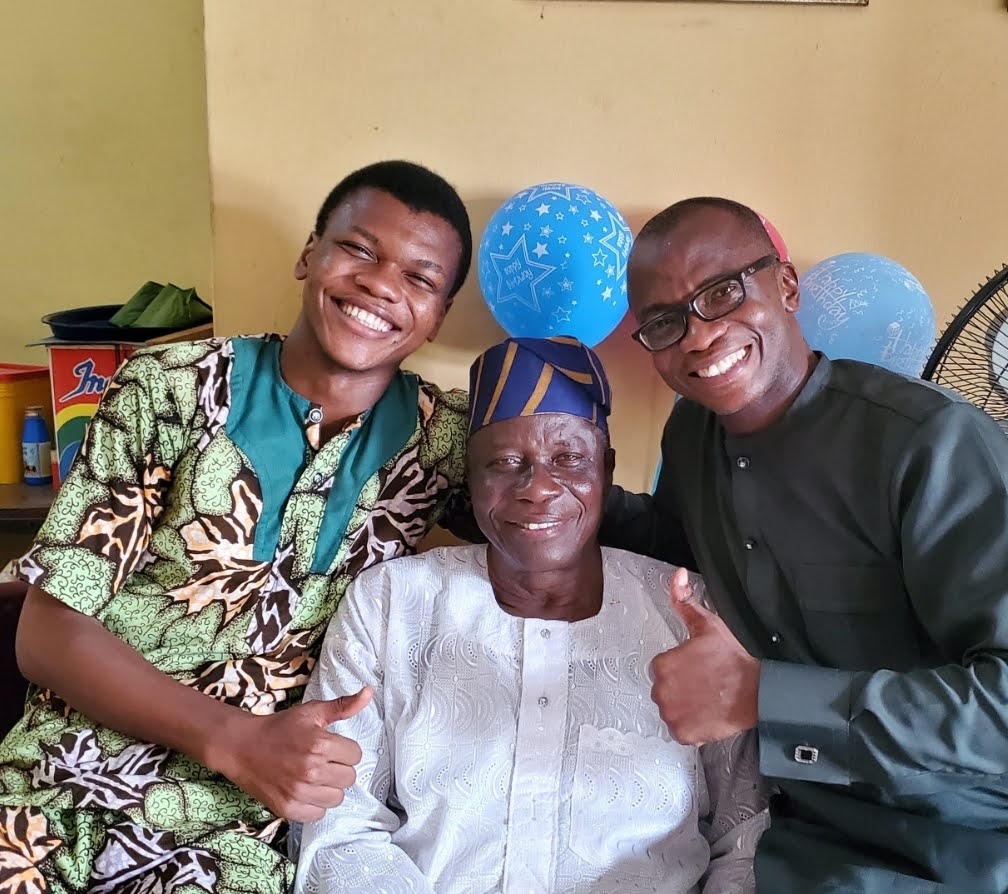 Left to Right: Myself, my father, my brother.
I have two Notion pages where I note the lessons from my dad and mum. After losing my dad, I opened the page and I had a sad realisation that I won’t be actively adding to the document anymore. Well, except retrospectively as I remember more precious teachable moments.
Some years ago, my father told me that very soon, I would remember his words and say "this man told me these things; he was right." Here I am, doing more than just saying he told me these things; I am putting them into writing.
In this piece, I want to share some advice from my father with the intention that it benefits you, the reader, and it serves as sadaqah jariyah (ongoing charity) for my father.
Before I proceed, here’s something to note:
Each piece of advice is a lived experience for me. I have poorly applied, forgotten and been negligent about each one at various points in my life and faced the music. They are now more than just advice and have become lessons.
For you the reader, it may be different if this is your first encounter with these ideas. I also recognise that not everyone has had the opportunity to have this kind of relationship with their father. That said, I hope you find the lessons useful; perhaps you’ll remember after failing to follow them and facing your own consequences :-)
I classify the lessons into these categories:
- Life’s Challenges
- Record Keeping
- Procrastination and Prioritisation
- Agency
On Life’s Challenges
In the year 2014, I wrote the Joint Admission Matriculation Board examination. I scored just below 200 which was not enough to study what I wanted; I failed. The implication was that I had to wait one year before getting another shot at a university admission. I remember crying for days as I was utterly disappointed with myself. The fact that I was considered an exceptional student at secondary school made it worse.
In those moments, I expected my dad to be furious and show it. To my surprise, he acted as though nothing life-changing happened. He brushed it off as failure being part of life, regularly counselling me that life is not a bed of roses. I remember him saying that I had to pick myself up, find something else to do for the year, and prepare harder for the next examination.
I would experience more challenges in the following years and my father did not shy away from encouraging me to stay strong in the face of adversity. He would remind me that facing challenges is an expected part of being alive, so they should neither cause me to give up nor stay moody. Instead, I should accept them for what they are. He would then tell stories of various challenges he himself had faced from various perspectives: business, career, people, and community. "Life is not a bed of roses," he would say, "it won't always be smooth."
One conversation that is etched in my mind forever is one I had with him when an acquaintance died. He told me that to live is to feel the pain of losing one’s loved ones. The only way to avoid that is to not live, in which case, others will feel that pain. To hear that from someone who lived for 82 years is to hear the absolute truth.
In teaching me to expect trials, my father would also teach me to always have a contingency plan. This lesson he would pass across both by words and deeds. He really liked to teach by example. Many times if he wanted me to do something for him, he would mention it, then follow up with "but this may not work; if it doesn't work, you should do this instead."
One of his favourite examples was when we purchased items for the home. For some items, he would buy more than the required quantity and mention that they would likely be out of stock in a couple of months. Sure enough, when they were actually out of stock, he would give a lecture.
On Record Keeping
If you knew and worked with my father, it wouldn’t take long before you got a glimpse of how much of a documenting geek he was. While he had a good memory, he knew that relying on memory alone was a disaster waiting to happen, so he made sure everybody knew this. My father would document nearly everything. During conversations, if an event was referenced, he could stand up, go into his room and in a couple of minutes, produce a document with information about that event with its dates.
When I was much younger, in a bid to cultivate a culture of documenting in me, my father would get me a folder. He would encourage me to do my record-keeping in it. For certain documents, he made photocopies, giving me some and keeping some himself.
After his passing, when helping to clear his room, I had a lot of “oh”s and “ah”s at the amount of documenting he did. Record-keeping is a habit I still need to improve on, as it does not come naturally to me yet. I have enjoyed its dividends. It always feels good when I try to remember something that happened a while ago and I am able to reference some document and keep things moving.
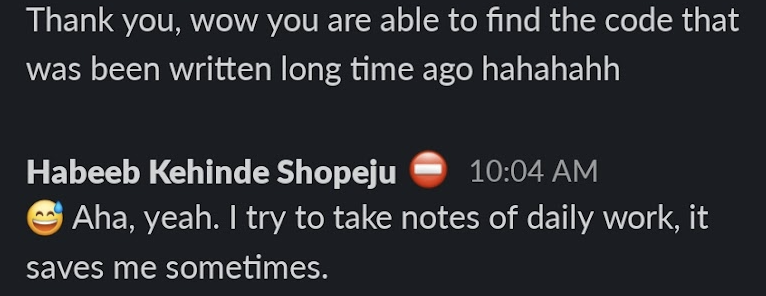 A work colleague was surprised that I could still find throwaway code a long time after.
In my lazy moments I feel like it is unnecessary work and engage in self-deceit by relying on memory, telling myself that I would not forget. You do not need to be a seer to know that I almost always end up forgetting. In those cases, the feelings of self-let-down are often worse because I expect that I would have had some documentation in place only to find out that I did not.
On Procrastination and Prioritisation
By far, the most frequent advice I got from my father was "do not leave till tomorrow what you can do today." It almost became his motto in my eyes. As I grow older, I realise that my dad was well aware that procrastination is the thief of time and assassination of all destinations.
Anyone who worked with my dad would probably experience his tendency to just do things himself if someone else was taking too long to do it. He was aware that everything cannot be done immediately, but he was also big on possessing a sense of urgency. So if he noticed me procrastinating and could sense the BS in my excuses, he would hit me with a "do not leave till tomorrow what you can do today."
Those words have been so ingrained in me that I can hear his voice as I write this, and my wife has heard me say those words countless times. That said, if you then think that I do not procrastinate anymore, you would be completely wrong. I still tend to put things off and I feel like I disappoint my father when that happens. I honestly do not think I can eliminate it, but I am more aware when it is happening, giving me a chance to course-correct if it is vital and urgent.
Procrastination is the enemy of prioritisation. When people talk about procrastination, it is often about it being a means to avoid doing anything. But there is one step after that: procrastination as a means to do everything but the hard, important things.
My father was very much aware of this second step. So while I could be working on something valuable, he would acknowledge that and then give me a lecture on prioritising properly. His advice would be something like, "Habeeb, you are doing B but A is undone. There is a limited time to do A; if the opportunity to do A goes, can you still do it? No. But if you do A, you can always then come back to do B."
As I grew older, when I made poor prioritisation choices, I would remember my dad. When I made good prioritisation choices, I would even call him to tell him how his advice helped. I can’t tell him anymore, but I am grateful.
On Agency
When my father asked me to do something, my much younger self would try to bail by simply telling him it couldn’t be done. Then he would ask "have you tried?" Well, the answer was usually no. Like clockwork, I would then go and try, with probably the most lacklustre attempt he has ever witnessed. He would then come and do it himself, showing me that:
- It could be done; I just did not try.
- I tried, but I just did not try properly.
Those teachings have stayed with me till today. Such that when working on a task, perhaps feeling tired and tending to do a poor job, I would remember his disapproval. This has also caused me to think twice before I blurt out “it cannot be done” just because I currently do not know how to do something.
I may not have realised then, but he was instilling the belief that I could take control of things and largely influence the outcome. This is a trait I can see in all my siblings. I cannot count the number of times I have seen them go the extra mile to succeed, stand out and shine. These outcomes are usually attributed to the grace of God, but one can also see the effort involved.
As I come to the end of this article, I realise that I learnt a lot of these lessons when I was a teenager. A point in my life where I had the teenage tendency to hold everything else accountable but myself. When my father would ask me to do something and I did not do it properly, I would easily say it was not my fault. Dad would tell me, and I quote, "a bad workman always blames his tools," then proceed with a lecture on how this was a skill issue and I should look inward.
Now that the years have rolled by, I have come to my own conclusion that there really are bad tools for a job. But I also acknowledge that one requires knowledge to be able to tell that. If I do not have the expertise to judge if a tool is bad or use it properly, I do not go around blaming my tools. When I do, I hear his voice in my head, catch myself, and go through a moment of introspection.
Final Words
After days of contemplating if I should write this piece or not, I am glad I did it. Indeed, I felt a flush of emotions in the process. At the start of the article, I said I was hoping you find it useful. Ironically, I think I would be the one returning to it in the future.
As a parting shot, I would narrate a time in my life when he would teach me something beneficial—it was valuable then, remains so now, and will be in the future.
My handwriting was poor; it still is. So some years ago, my father paid extra attention to my writing and would scold me a lot because of it. He would then enrol me in handwriting classes every Saturday, probably for one year until those classes stopped running. He would say to me: "it does not matter how intelligent or knowledgeable you are; nobody would read what you are writing if it is illegible." In essence, it does not matter how good my work is; it would be dead in the water if I am unable to communicate what was done to someone else.
Share on
Twitter Facebook LinkedInHow did this post make you feel?




Leave a comment